


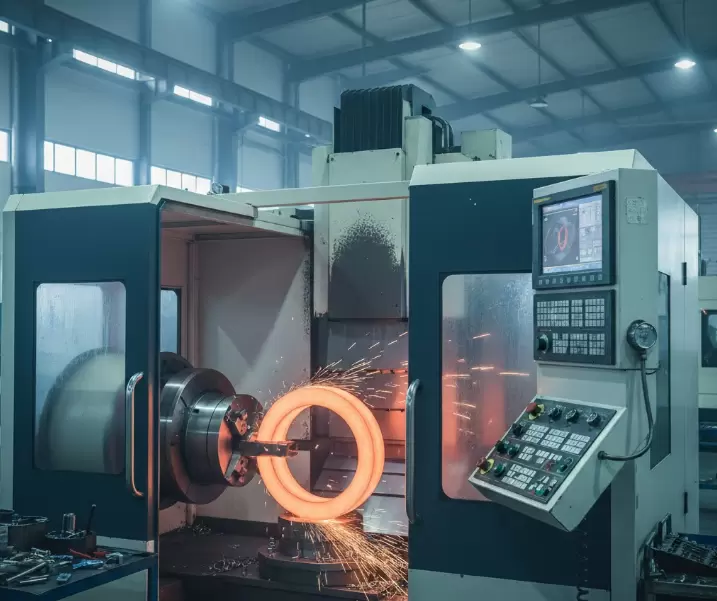
In industries where structural integrity, fatigue resistance, and long-term reliability are non-negotiable, the importance of ring forged parts cannot be overstated. These components are widely used in aerospace, energy, petrochemical, and heavy machinery sectors, where they must perform under extreme loads, high pressures, and demanding thermal conditions.
Compared to cast or machined alternatives, forged rings offer a clear advantage: optimized grain flow structure, which directly enhances mechanical strength and resistance to cracking. Manufacturers like Jiangxi Hongdu Precision Machinery have continuously refined ring forging processes through advanced equipment and strict quality control, ensuring consistent performance across critical applications.
What Is Ring Forging and Why It Matters
Ring forging is a specialized metal forming process in which a heated billet is shaped into a ring through controlled compressive forces. Unlike other manufacturing methods, forging aligns the internal grain structure of the material along the geometry of the part.
This results in:
- Improved tensile strength
- Higher fatigue resistance
- Enhanced structural uniformity
- Reduced internal defects
The process typically involves heating a metal billet to a specific temperature, followed by deformation using dies or rolling systems to achieve the desired ring shape. This controlled deformation not only defines the geometry but also optimizes the internal metallurgical structure.
Key Advantages of Ring Forged Components
1. Superior Strength and Fatigue Resistance
Forged rings exhibit a dense and continuous grain structure, making them significantly stronger than cast or machined counterparts. This is especially critical in applications where failure could lead to serious operational or safety consequences.
2. High Precision and Dimensional Consistency
At Jiangxi Hongdu Precision Machinery, advanced CNC machining and inspection systems are used to ensure tight tolerances and repeatable accuracy. This is particularly important in industries like aerospace, where even minor deviations are unacceptable.
3. Long-Term Cost Efficiency
Although forging may require higher initial investment, it often reduces overall production costs by:
- Minimizing material waste
- Reducing machining time
- Extending component service life
This makes ring forging a cost-effective solution over the product lifecycle.
4. Material Versatility
Ring forging can be applied to a wide range of materials, including:
- Carbon and alloy steels
- Aluminum alloys
- Titanium and high-performance metals
This flexibility allows manufacturers to meet diverse requirements—from lightweight aerospace components to heavy-duty industrial parts.
How Ring Forged Parts Are Manufactured
At Jiangxi Hongdu Precision Machinery, the production of ring forged parts follows a carefully controlled, multi-stage process:
Material Selection
The process begins with selecting high-quality raw materials that meet strict industry standards. Close collaboration with suppliers ensures material consistency and traceability.
Controlled Heating
Billets are heated in precision-controlled furnaces to achieve optimal forging temperatures. Proper heating is essential to ensure material plasticity and prevent defects.
Forging Process
Using advanced hydraulic presses or ring rolling systems, the heated billet is shaped into a ring. Process parameters such as pressure, deformation rate, and temperature are carefully monitored to ensure uniformity.
Machining and Finishing
After forging, the rings undergo CNC machining to achieve final dimensions and surface quality. This step ensures that each component meets exact design specifications.
Inspection and Testing
Before delivery, each part is subjected to rigorous quality checks, including:
- Dimensional inspection
- Non-destructive testing (NDT)
- Mechanical property verification
This ensures that every forged ring meets performance and safety requirements.
Where Ring Forged Parts Are Used
Aerospace Industry
Ring forged components are commonly used in:
- Engine mounts
- Landing gear systems
- Structural support elements
These applications demand maximum strength-to-weight ratios and reliability.
Automotive Sector
In automotive manufacturing, forged rings are essential for:
- Drivetrain components
- Bearing rings
- Gear systems
They provide the durability required for high-load, high-speed operation.
Oil, Gas, and Energy Industries
Ring forged parts are widely used in:
- Valves and flanges
- Pressure vessels
- Pipeline systems
These components must withstand extreme pressure and temperature conditions.
Heavy Machinery
Applications include:
- Large bearings
- Rotating equipment components
- Structural rings for industrial systems
These require long service life and resistance to wear and fatigue.
Why Jiangxi Hongdu Precision Machinery?
Jiangxi Hongdu Precision Machinery has built a strong reputation by focusing on:
- Advanced forging and machining capabilities
- Strict quality control throughout production
- Continuous process optimization
- Customized solutions for different industries
By combining material science expertise with precision manufacturing, the company delivers ring forged parts that meet the evolving demands of global industries.
Final Thoughts
Ring forging is more than a manufacturing method—it is a critical engineering process that directly determines the performance and reliability of key components. With superior mechanical properties and structural integrity, forged rings are indispensable in high-performance applications.
Through its commitment to quality, innovation, and technical excellence, Jiangxi Hongdu Precision Machinery continues to provide high-performance ring forged solutions that support long-term operational success across industries.

 hebrew
 French
 Russian
 Arabic