


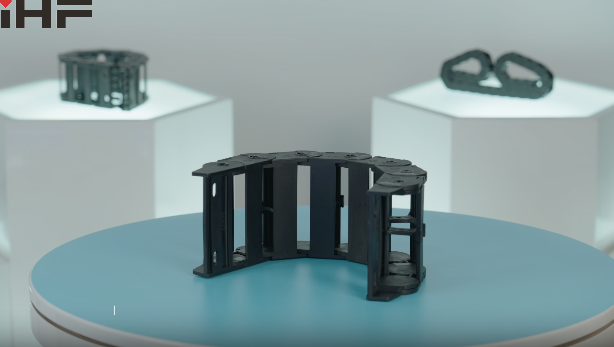
The 3C industry—encompassing computers, communications, and consumer electronics—is driven by speed, precision, and compact system design. Modern production lines operate with rapid acceleration, tight spatial constraints, and continuous motion cycles. In such demanding environments, every mechanical component must perform reliably—including one that is often underestimated: the cable carrier.
Far from being a simple accessory, the 3C equipment cable carrier plays a central role in ensuring stable operation, protecting critical wiring systems, and maintaining long-term equipment performance.
The Role of Cable Carriers in 3C Equipment
Cable carriers are designed to guide and protect various transmission elements, including:
- Power cables
- Signal lines
- Pneumatic hoses
- Fiber optics
In high-speed automation systems, improper cable management can lead to signal interference, mechanical wear, or even unexpected downtime. A well-designed cable carrier ensures smooth motion, protects cables from damage, and supports consistent system performance.
Manufacturers like iHF Group recognize that in 3C applications, cable carriers must be engineered as integral components of the motion system—not treated as secondary add-ons.
Key Features of High-Performance 3C Cable Carriers
1. Compact Structure for Space-Constrained Equipment
3C machinery is typically highly integrated, leaving very limited room for component installation. Cable carriers must therefore offer:
- Slim and lightweight outer profiles
- Efficient internal layouts for multi-cable routing
- Small bending radii for tight motion paths
A compact yet functional design allows engineers to optimize machine layouts without sacrificing cable protection or movement reliability.
2. High-Speed, Low-Noise Operation
Electronics manufacturing lines often run at high cycle speeds, requiring cable carriers to handle rapid reciprocating motion with minimal friction.
At the same time, many production environments—especially cleanrooms—demand low noise and minimal vibration. High-quality cable carriers are engineered to:
- Reduce mechanical noise
- Minimize vibration during movement
- Maintain smooth, stable operation over time
Precision-molded structures, like those developed by iHF Group, help achieve these performance goals.
Material Engineering: The Foundation of Durability
Wear Resistance and Long Fatigue Life
In continuous motion systems, materials must withstand millions of cycles without failure. Advanced polymer materials are commonly used to provide:
- High fatigue resistance under repeated bending
- Reduced wear between chain links
- Stability under varying temperatures
Reliable cable carriers are rigorously tested to ensure long service life in demanding conditions.
Cleanroom Compatibility
Many 3C production processes take place in controlled environments where contamination must be minimized. Cable carrier materials must therefore offer:
- Low particle generation
- Chemical resistance to oils, coolants, and cleaning agents
- Consistent performance without degradation
These properties are essential for maintaining product quality in sensitive manufacturing processes.
Structural Design for Complex Cable Management
Internal Separation and Organization
Modern 3C equipment often integrates multiple types of cables in close proximity. Without proper separation, issues such as signal interference or cable wear can occur.
Effective cable carriers incorporate internal separators to:
- Prevent cable entanglement
- Reduce friction between cables
- Maintain stable signal transmission
This is especially important in high-precision applications where even minor disruptions can affect product quality.
Handling Dynamic Loads and High Acceleration
Frequent starts, stops, and directional changes place significant stress on cable carriers. To handle these conditions, advanced designs focus on:
- Reinforced link structures
- Optimized geometry for load distribution
- Resistance to deformation under dynamic loads
Through engineering analysis and real-world testing, manufacturers like iHF Group ensure their products remain stable even under extreme motion conditions.
Typical Applications in 3C Manufacturing
SMT and PCB Assembly
In SMT production lines, cable carriers support pick-and-place machines, conveyors, and inspection systems. Stable cable routing is essential to maintain placement accuracy and avoid interruptions.
Semiconductor and Display Equipment
These applications demand ultra-smooth motion and minimal vibration. Cable carriers must protect sensitive signal cables while enabling precise linear movement.
Automated Testing and Inspection Systems
High-speed AOI and testing systems rely on uninterrupted data transmission. Cable carrier performance directly impacts signal integrity and system responsiveness.
How to Choose the Right Cable Carrier
Selecting the appropriate cable carrier requires careful consideration of system parameters, including:
- Travel distance and installation direction
- Operating speed and acceleration
- Cable size, quantity, and bending requirements
A mismatch between carrier design and application conditions can lead to premature failure or reduced efficiency.
Customization Matters
Standard solutions are not always sufficient for specialized 3C equipment. Customization options—such as tailored lengths, internal configurations, and mounting interfaces—ensure better system integration.
iHF Group offers application-specific designs that align closely with real-world operational needs.
Why Work with iHF Group?
With strong expertise in precision motion components, iHF Group provides cable carrier solutions specifically engineered for high-speed, compact automation systems. Their approach emphasizes:
- Material performance validated through lifecycle testing
- Precision manufacturing for consistent quality
- Application-driven design tailored to actual working conditions
This results in improved reliability, reduced maintenance, and longer service life.
Final Thoughts
Although often overlooked, the cable carrier is a vital component in 3C automation systems. Its performance directly affects machine stability, signal integrity, and overall production efficiency.
Choosing the right cable carrier—and the right manufacturing partner—can make a significant difference in long-term operational success. For companies operating in high-speed, high-precision environments, investing in a well-engineered solution is not optional—it’s essential.
https://www.ihffty.com/industry/engineering-reliable-motion-with-3c-equipment-cable-carriers.html

 hebrew
 French
 Russian
 Arabic