


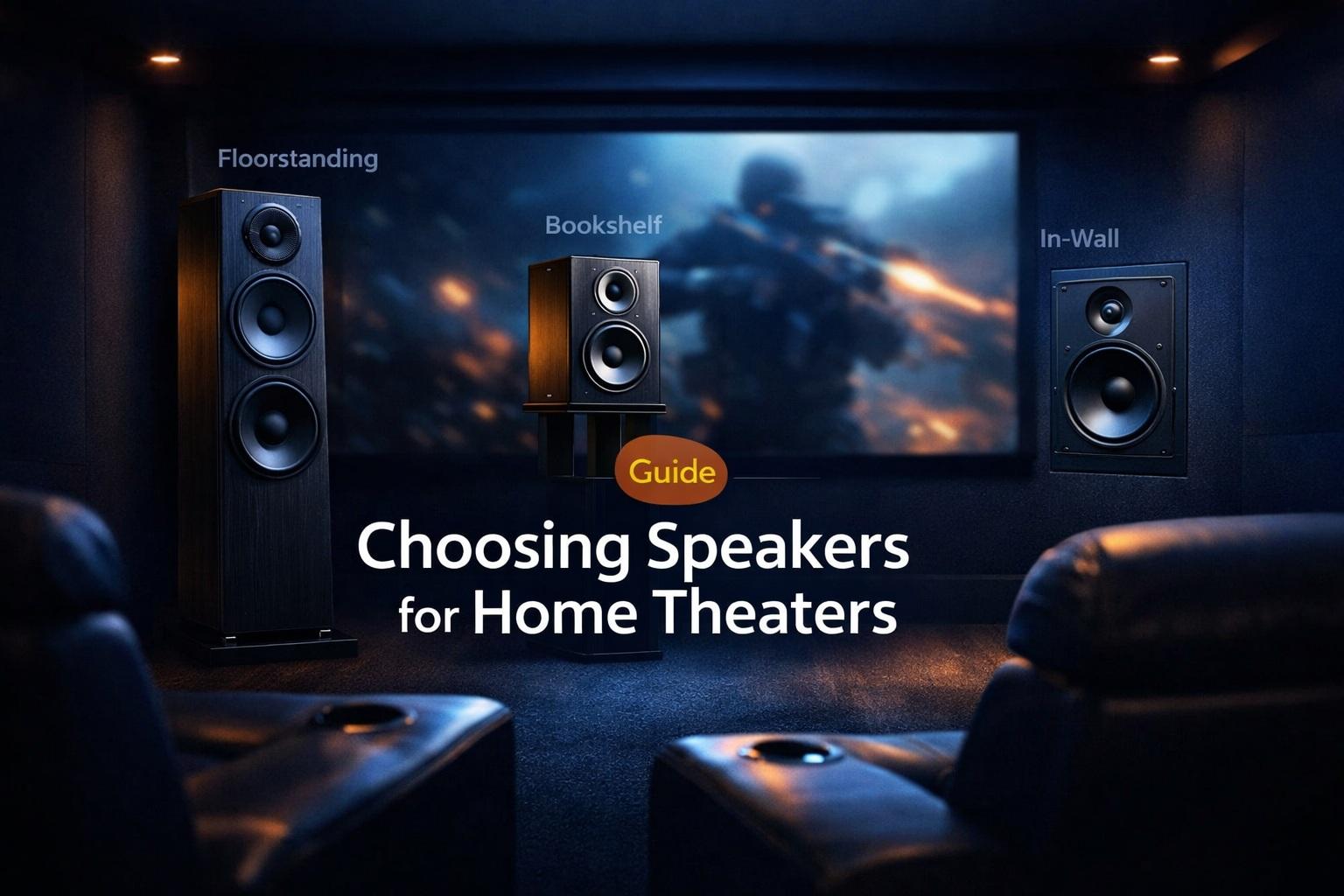
Speakers are the soul of a home theater system because audio defines clarity, impact and emotional engagement. Choosing the right home theater speakers and placing them correctly transforms images into immersive storytelling. In this long-form article I will unpack speaker topologies from stereo and 5.1 to object-based immersive formats, explain how speaker specifications translate into perceived performance, guide you through practical placement and toe-in strategies, describe subwoofer integration and room interaction techniques, walk through calibration and measurement best practices, and explain how speaker selection integrates with amplification, cabling and room aesthetics. The goal is to give you a practical roadmap so your system sounds as good as it looks.
Understand The Role Of Each Speaker In A Theater System
A home theater relies on specialized channels: left and right for imaging and musical body, center for dialog clarity, surrounds for ambient and directional cues, and low-frequency effects for impact. Height or overhead channels layer vertical realism in immersive formats. Each speaker has a role and must be chosen for that role: the center must match tonal character with the left and right for seamless panning; surrounds should produce diffuse, enveloping ambiance rather than distinct, localized images; subwoofers handle deep energy that defines explosions and musical weight. Choosing speakers without understanding these functional roles risks mismatch and uneven tonal balance.
Select Speaker Topology Based On Use Cases And Budget
The first technical decision is topology: will you build a stereo-focused room for music and movies, a 5.1/7.1 layout for classic surround, or an object-based immersive system such as Dolby Atmos? Stereo systems excel at music fidelity while 5.1/7.1 and Atmos layouts produce enveloping cinematic sound. Budget dictates how many high-quality drivers you can deploy: it is often better to invest in fewer, better-matched main speakers and a single high-quality sub than to buy many low-cost satellites. Understand the content you consume most and choose a speaker topology that accentuates that experience.
Speaker Specifications: What Actually Matters
Marketing specs can be misleading; prioritize parameters with real-world impact. Sensitivity affects how loudly a speaker will play for a given amplifier power; higher sensitivity reduces the need for massive amplification. Frequency response indicates extension, but room interaction often dominates low-frequency perception. Impedance informs amplifier matching—complex impedance curves matter more than nominal numbers. Driver materials and crossover design influence tonal coherence and power handling. The best approach is to audition speakers in a real room with real program material and to prefer systems that offer coherent tonal balance across the band rather than extreme bass or hyper-detail that becomes fatiguing.
Match Speakers Tonally For Seamless Imaging
Tonality matching across front channels is crucial. A center channel that sounds brighter or more colored than left and right will reveal dialog seams as panning occurs. Many speaker companies offer matched sets where center and surrounds share driver voicing and crossover philosophies. If mixing brands, prioritize timbre matching for the left/center/right triad even if surrounds come from different ranges. Tonal mismatch is one of the most common mistakes in mixed-brand systems and produces a disjointed soundstage.
Speaker Placement: Geometry Over Guesswork
Placement is geometry plus symmetry. The left and right speakers should form an equilateral or slightly wider triangle with the main listening position to produce accurate imaging. Toe-in adjusts the apparent image focus and tonal balance; modest toe-in often increases perceived detail and imaging precision. The center speaker should sit directly above or below the display and be angled to match the vertical plane of the listener’s ears. Surround speakers should be placed slightly above ear height and behind the listening position for diffuse ambience. When installing height channels, aim for an even vertical array and avoid placing height speakers where they reflect in an uncontrolled fashion off the ceiling.
Subwoofer Integration: Placement, Tuning, And Multiple Subs
Low frequencies are room-bound and omnidirectional, so subwoofer placement requires experimentation. Start with one high-quality sub placed near the front half of the room and measure response at the listening position. Use the “subwoofer crawl” to find positions where room modes are minimized. For large rooms or to smooth modal behavior add a second sub at an offset location; multiple subs average room response and reduce peaks and nulls. Use the processor’s crossover and filters and set slopes so subs integrate smoothly with mains. Avoid over-equalizing subs to mask room problems—treat EQ as a fine-tuning tool after physical placement.
Room Acoustics And Their Interaction With Speakers
Speakers do not exist in a vacuum—the room sculpts sound dramatically. First reflections from side walls and ceilings blur imaging; apply absorption at first-reflection points to preserve direct sound. Bass traps in corners control low-frequency build-up that muddies the midrange. For surround speakers a controlled amount of diffusion can preserve spaciousness without creating uneven reflections. Acoustic work should be measured and iterative: install paneling, measure, and refine rather than guessing at coverage amounts.
Amplifier Matching And Headroom Considerations
Amplifier choice matters beyond wattage. Look for low distortion at realistic listening levels and enough headroom to handle dynamic peaks without clipping. For speakers with modest sensitivity, ensure ample power is available to maintain control and dynamics. Multi-channel amplification can improve stability and reduce crosstalk between channels. For high-end systems consider separating pre/pro and power amplification to reduce heat and to place amplification closer to speakers where long runs would otherwise cause loss.
Cabling, Connectors, And Termination Best Practices
Use high-quality speaker cable of appropriate gauge to minimize loss and preserve damping factor. For runs under 20 feet 14–16 gauge is common; for longer runs move to 12 gauge. Make robust terminations with properly splayed conductors on binding posts or use spades to ensure secure mechanical contact. Label both ends of each run and document polarity before final connection. Balanced line-level wiring for active speakers and subwoofers reduces noise; for long cable runs use shielded interconnects and keep power and signal cables separated.
Calibration And Measurement: The Science Of Listening
Calibration converts potential into result. Use a calibrated measurement microphone and software or the processor’s room correction to measure frequency response, time alignment, and speaker levels. Start with flat on-axis response and then apply room correction conservatively—don’t use EQ to create an artificial tone. Time alignment for accurate imaging is essential: use delay settings to ensure sound from all speakers arrives in phase at the listening position. Validate the final tuning with familiar program material and refine by ear; measurement and listening together create the best result.
Maintenance And Longevity Of Speakers
Speakers are robust but benefit from periodic checks. Dust woofer surrounds and tweeter domes carefully, verify grille attachment and inspect driver cones for discoloration or cracking especially in older paper-based drivers. For active speakers ensure cooling vents are unobstructed. Keep amplifiers and processors on a stable power supply and protect the system with surge protection. Document firmware versions for powered or DSP-based speakers and update conservatively, testing critical content after each update.
Aesthetic Integration And Concealment Strategies
Speakers need not dominate decor. In-wall and in-ceiling speakers offer a low-visual footprint while delivering impressive performance when properly specified and installed. For front channels consider behind-screen placement with an acoustically transparent screen for a truly seamless look. If visible speakers are desired, choose finishes and grill materials that match room decor and avoid glossy surfaces that reflect light onto the screen.
Phased Upgrades And Future-Proofing
Audio tastes and formats evolve. Build an infrastructure that supports upgrades: run conduit for future speaker runs, place extra amplifier space in your AV rack and reserve network bandwidth for immersive audio services. Start with a solid front stage and a reliable subwoofer; add surrounds and height channels later as budgets permit. Keeping a modular mindset prevents wasted purchases and ensures incremental improvements pay off.
Real-World Example: Building A Balanced 7.1.4 System
For a medium dedicated room a sensible path is to choose high-quality floorstanders for L/R, a matched center channel, bookshelf surrounds for side and rear positions, two subwoofers for bass smoothing and four height speakers for Atmos. Use a robust processor with room correction and separate amplification for fronts. Careful speaker placement, riser geometry and acoustic treatment yield a system that renders dialog with clarity and delivers visceral impact without fatigue.
Conclusion
Home theater speakers are the final act that turns pixels into presence. Thoughtful selection, careful placement, acoustic alignment, and measurement-driven calibration produce systems that engage and endure. Match speakers tonally, integrate subs thoughtfully, prioritize acoustics and plan for phased upgrades. With careful attention to these principles your home theater will deliver both emotional impact and technical fidelity season after season.

 English
 hebrew
 French
 Russian