


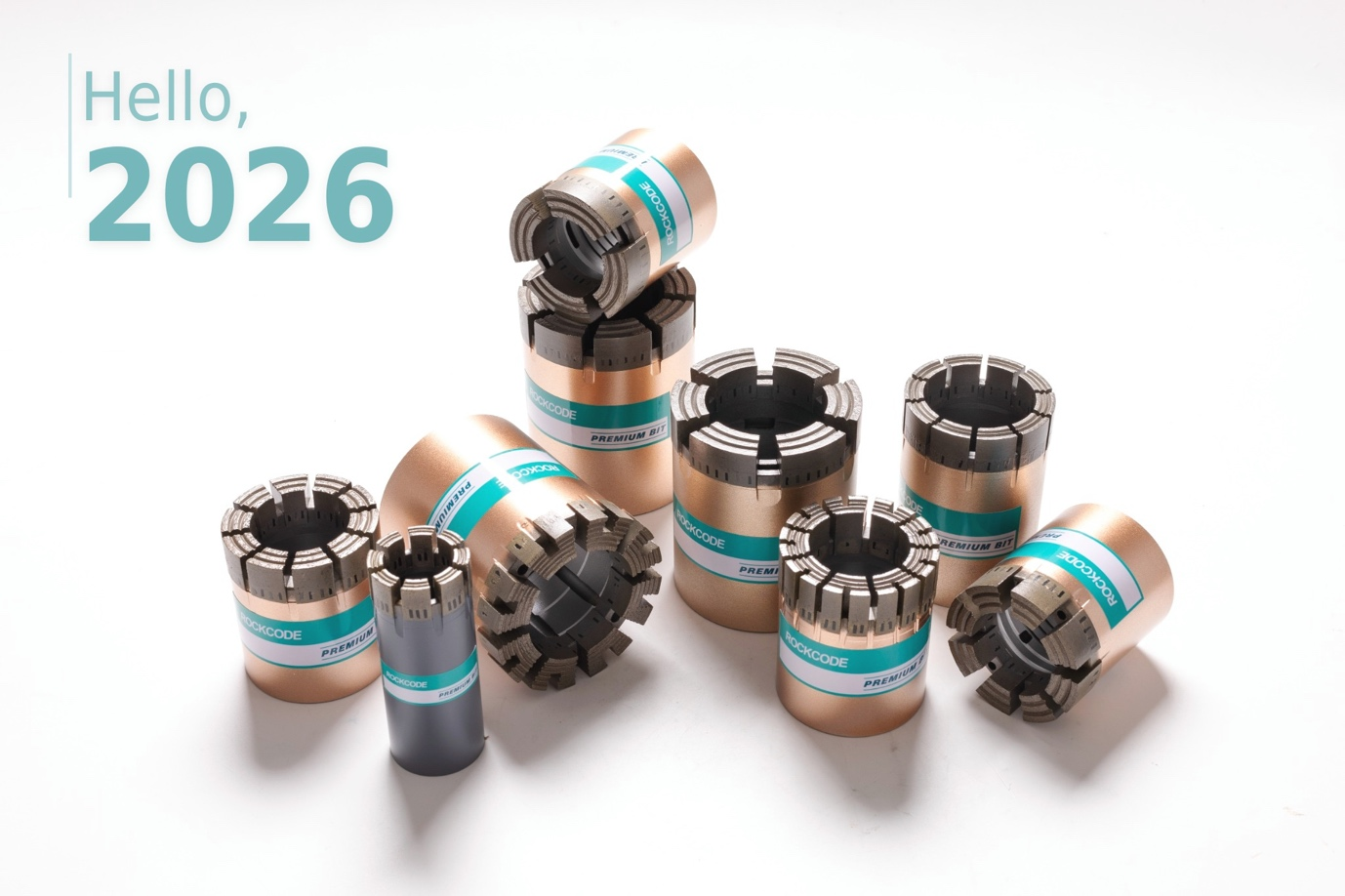
The function of waterways in a diamond drill bit is straightforward:to remove cuttings and heat from the diamond cutting points as efficiently as possible.
Water pressure and water volume are both critical. Excessive pressure combined with high rotational speed can generate unnecessary heat, accelerate matrix wear, and reduce diamond life. Insufficient flow, on the other hand, leads to poor cuttings removal and bit blocking.
For this reason, modern diamond bits are designed with carefully controlled waterways to regulate fluid speed, not just total flow.
Number and Arrangement of Waterways
The number of waterways is generally related to bit size:
-
Small-diameter bits are commonly fitted with two waterways
-
Larger bits often require four or more
-
In some uranium drilling operations, eight waterways or more are standard practice
There is no single correct design. Some operators claim that eliminating waterways entirely forces water to pass more evenly across the bit face. While this can work under controlled conditions, it places greater importance on pump pressure and fluid management.
Waterway design must also consider the drilling medium. Water, mud-fluid, and compressed air behave differently and affect cooling efficiency, matrix abrasion, and cuttings transport in different ways.
Fluid Type and Matrix Wear
Fluid flow affects three interacting factors:
1. Clearance of cuttings
2. Cooling of diamond points
3. Abrasion of the bit matrix
Mud-fluid is used in a small percentage of rock drilling but is more common in oilfield applications. Although it is not always abrasive, in many cases it causes significant matrix wear, especially at high flow velocities.
This is one reason why waterway geometry and surface finish require careful attention in bit design.
Temperature Effects on Diamonds and Bit Matrices
In mechanically set and impregnated bits, the melting point of the matrix alloy must remain below the temperature at which diamonds are damaged.
Most matrix alloys used in diamond drilling melt below 2000°F (≈1090°C). Powder metal matrices are sintered rather than fully melted, which allows diamonds to be retained without exposure to damaging temperatures.
Tungsten carbide itself has a very high melting point. It is the binder metals, typically cobalt and similar alloys, that sinter or melt to form the metallic structure holding the diamonds.
To avoid graphitization of diamonds during manufacturing:
-
Temperature must be tightly controlled
-
Time at elevated temperature must be limited
-
A controlled atmosphere is required
Some low-melting alloys can liquefy at very low temperatures, even near the boiling point of water. These alloys were historically used to protect diamonds but offered limited mechanical strength.
Thermal Shock During Drilling
Diamond damage does not require extreme heat.Rapid cooling of a hot bit—such as suddenly turning wash water back on after dry drilling—can crack or weaken diamonds. This type of thermal shock is a common cause of premature bit failure.Consistent circulation is therefore more important than maximum flow.
Special Bits and Non-Coring Applications
In many exploration and underground drilling situations, non-coring bits provide faster and more economical drilling.
Typical use cases include:
-
Drilling through overburden
-
Advancing quickly to a known target depth
-
Test holes where continuous core is not essential
While core loss is a disadvantage, the increase in penetration rate and reduction in rod handling can result in substantial time and cost savings.
In kimberlite formations, where rock is soft but contains very hard boulder inclusions, specially designed non-coring bits with impregnated tungsten carbide and compressed air cooling have proven effective.
Casing Shoes, Pipe Shoes, and Bottom Discharge Bits
Casing shoe and pipe shoe bits are used for penetrating overburden and collaring casing into bedrock. They are essential where hole stability must be maintained during the early stages of drilling.
Bottom discharge bits are designed for very soft or talc-rich formations. Instead of water flowing between the bit and core barrel, fluid is directed through holes in the bit wall and discharged at the bit face. This prevents washing away fragile core and requires a specially designed core barrel system.
Reaming Shells and Special Reamers
Reaming shells are annular diamond tools with diamonds set only on the outer circumference. They are mounted behind the bit to maintain hole diameter.
Standard practice is to use reaming shells in sets of two or more. In deeper holes, alternating shells every 50 ft helps maintain uniform gauge wear.
Once shell wear reaches approximately 0.012 in (0.3 mm) below the original set diameter, the shell is usually replaced or reassigned to shallow drilling.
Special reamers and underreamers are used to enlarge holes for casing installation or to ream below existing casing. Insert-type designs use expandable diamond-set lugs activated mechanically or by circulating water pressure. These tools are effective in AX, BX, and NX holes but less reliable in very small diameters.
→ For more information about ROCKCODE’s Products, please visit: https://www.rockcodebit.com/drill-bits-products
→ Email us at: info@rockcodebit.com
→ Information in this article is for general reference only. For specific drilling projects and drilling bits, please consult qualified professionals. Thank you.
Source
【1】Cumming, J. D. (1956). Diamond drill handbook. (2nd ed.). Smit.
https://www.rockcodebit.com/waterways-and-fluid-flow-in-diamond-drill-bits.html

 hebrew
 French
 Russian
 Arabic